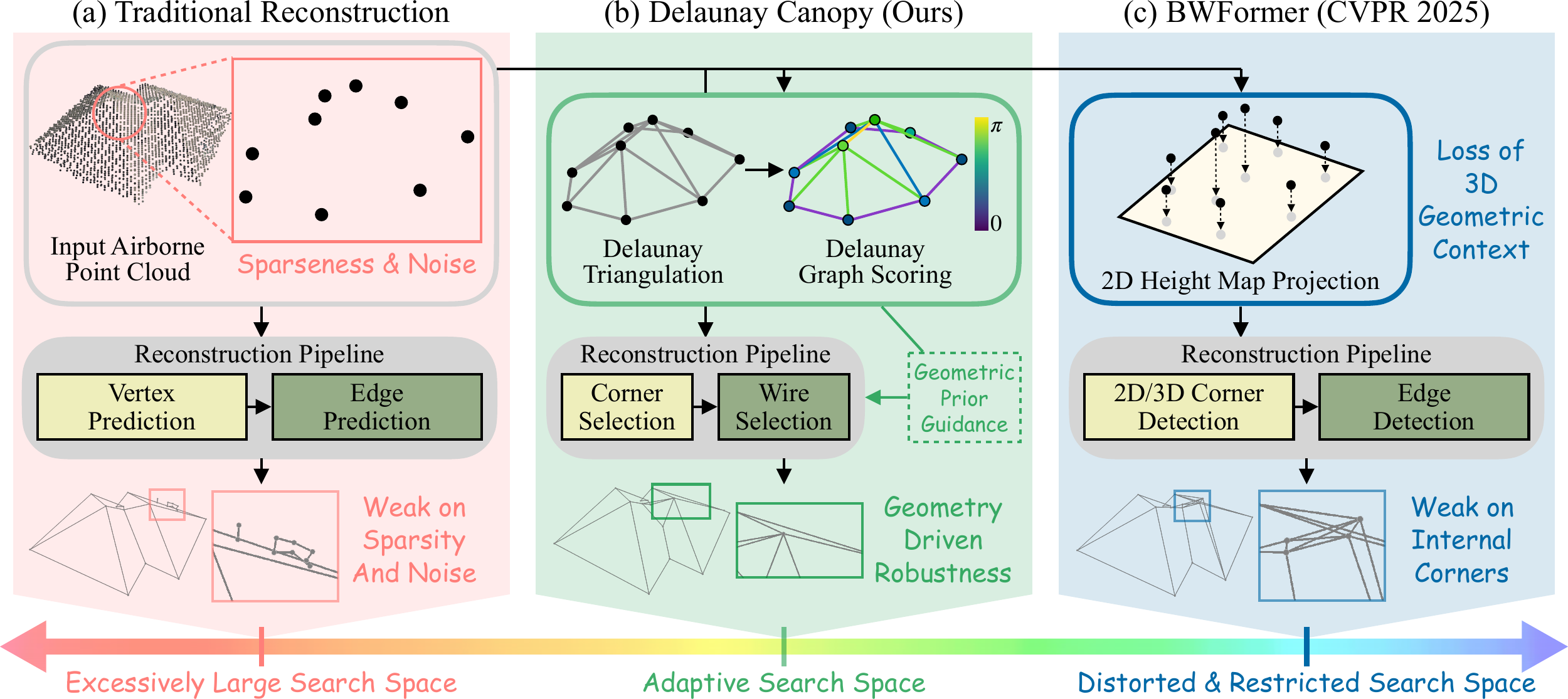
Delaunay Canopy scores a Delaunay graph with geometric priors to
reconstruct building wireframes precisely, even in sparse, noisy, and internal-corner regions.
Delaunay Graph Scoring
Delaunay triangulation quantifies local curvature, transforming the underlying surface geometry
into essential curvature signatures.
Adaptive Search Space
Corner and wire selection leverages the geometric cue to adaptively adjust the search space,
focusing the model on probable candidates.
State of the Art
State-of-the-art results on the Building3D Tallinn city and entry-level datasets, supported by
a comprehensive experimental study.
Overview
From point cloud to wireframe
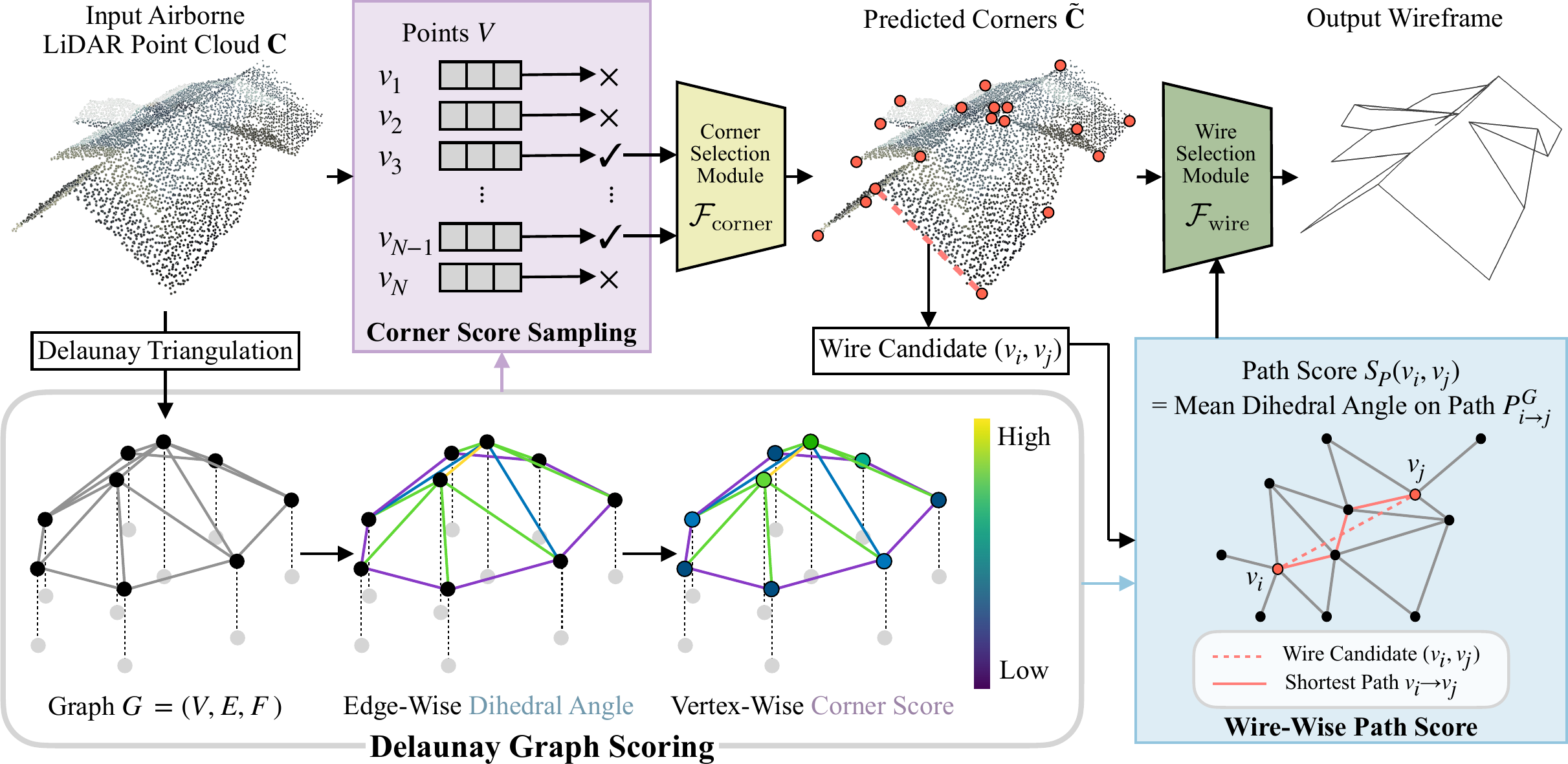
01Delaunay Graph Scoring. Delaunay triangulation approximates the underlying surface of the point cloud, then region-wise curvature metrics are computed for each element in the order of face, edge, and vertex.
02Corner Selection. Leveraging the vertex-wise prior, corner score sampling isolates a small, geometry-aware subset of points likely to represent true corners, and the corner selection module refines them into the final corners.
03Wire Selection. Leveraging the edge-wise prior, each wire candidate takes a path score averaged along its shortest Delaunay path, and the wire selection module uses that score to determine valid wires.
Delaunay Graph Scoring
Curvature signatures from geometry
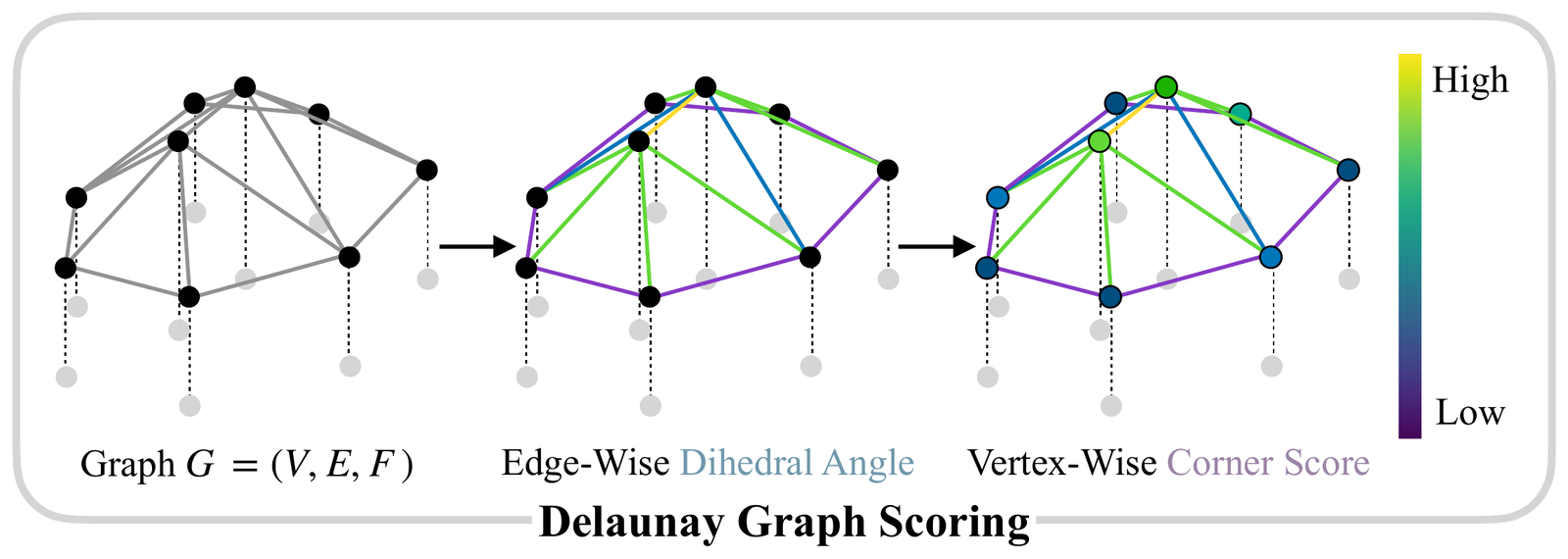
We apply Delaunay triangulation to the airborne LiDAR building point cloud to approximate its
underlying surface. This process generates a Delaunay graph \(G = (V, E, F)\), and geometric priors
for curvature characterization are assigned to its faces, edges, and vertices in turn.
Face Normal Computation
For every face within the Delaunay graph, the normal vector is computed from its three
constituent vertices.
Edge-Wise Dihedral Angle
For every edge, the dihedral angle is the angle between the normal vectors of its two adjacent
faces. A large dihedral angle signifies a sharp fold or corner where the two adjacent faces
meet.
Vertex-Wise Corner Score
For every vertex, the corner score is determined by aggregating the dihedral angles of all its
incident edges into their mean. A high corner score suggests that the vertex is highly likely to
be an actual corner of the building.
Corner Score Sampling
Sampling where corners live
As shown below, each panel samples the points with the highest corner scores, first 500 and then 150.
While farthest point sampling performs a uniform sampling, corner score sampling retains points located
in areas of pronounced curvature (roof corners and edges), making them highly probable corner
candidates. The corner selection module then refines this focused subset into the final set of
predicted corners.
Wire-Wise Path Score
Curvature along the shortest path
Wire Candidate
Shortest Path
For each wire candidate connecting two predicted corners, we first find the shortest path
between them on the Delaunay graph. The edges along that path share the same local region as
the wire candidate, so averaging their dihedral angles gives a path score that represents the
wire curvature.
Through prior-based query scaling, each wire query is then modulated by its path score, which
acts as a scale factor that rescales the query. This damps low-score wires and emphasizes
high-confidence ones, focusing the model's attention on geometrically plausible structures and
leading to stable and accurate wire predictions.
Qualitative Results
From input to reconstruction
Drag the divider to wipe between the input point cloud and the reconstructed wireframe. Drag
anywhere else to orbit, scroll to zoom. Each building turns on its own. Auto-rotation pauses the
moment you grab a view.
Qualitative Results
Recovering Interior Corners
Against the strongest baseline BWFormer, on challenging cases with complicated roof structures.
Fully leveraging 3D geometric context, a capability often absent when only 2D information is
employed, facilitates superior detection of interior corners in addition to those on the periphery.
Each row is one building, with the input on the left and the two reconstructions sharing the right
cell. Drag the divider there to swap between them, drag anywhere else to orbit.
Qualitative Results
Complex Buildings
Our framework exhibits strong robustness across challenging real-world scenarios, successfully
handling highly complex geometrical cases. Drag a divider to wipe between the input and the
reconstruction, drag anywhere else to orbit.
Quantitative Results
State of the art on Building3D
Citation
BibTeX
@inproceedings{kim2026delaunay,
  title        = {Delaunay Canopy: Building Wireframe Reconstruction from Airborne LiDAR Point Clouds via Delaunay Graph},
  author       = {Kim, Donghyun and Kim, Chanyoung and Kwon, Youngjoong and Hwang, Seong Jae},
  booktitle    = {European Conference on Computer Vision (ECCV)},
  year         = {2026}
}